Casino games with the best odds
The lowest house edges belong to blackjack with basic strategy, craps pass line with odds and baccarat Banker. The ranking below gives each edge with the rules it assumes.
House edge ranking
No row matches your search.
Start with the lowest long-run house edge, but read the rule column before treating any game as comparable.
Game | Bet or rules | House edge |
|---|---|---|
Craps | Odds behind the line, true odds | 0.00% |
Blackjack | Basic strategy; S17, DAS, late surrender, 3:2 | 0.48% |
Baccarat | Banker, 5% commission | 1.06% |
Baccarat | Player | 1.24% |
French roulette | Even money with La Partage | 1.35% |
Craps | Don't pass or don't come | 1.36% |
French roulette | Even money with En Prison | 1.39% |
Craps | Pass or come | 1.41% |
Baccarat | Commission-free banker (6 pays 1:2) | 1.46% |
Craps | Place 6 or 8 at 7:6 | 1.52% |
Blackjack | Blackjack pays 6:5 | 1.83% |
European roulette | Any bet | 2.70% |
Sic Bo | Small or big | 2.78% |
Craps | Field with 3:1 on 12 | 2.78% |
Mini roulette | 1:1 bet that loses half on zero | 3.85% |
Craps | Place 5 or 9 at 7:5 | 4.00% |
Baccarat | Tie at 9:1 | 4.84% |
American roulette | Any bet except the top line | 5.26% |
Craps | Field with 2:1 on 2 and 12 | 5.56% |
Blackjack | Mimic the dealer | 5.67% |
Blackjack | Never bust | 6.08% |
Craps | Place 4 or 10 at 9:5 | 6.67% |
Mini roulette | Single number at 11:1 | 7.69% |
Sic Bo | Single number | 7.87% |
American roulette | Top line at 6:1 | 7.89% |
Craps | Hard 6 or 8 at 9:1 | 9.09% |
Big Six wheel | $1 segment | 11.11% |
Craps | Any craps at 7:1 | 11.11% |
Craps | Hard 4 or 10 at 7:1 | 11.11% |
Craps | Hop on 2 or 12 at 30:1 | 13.89% |
Sic Bo | Any triple at 30:1 | 13.89% |
Baccarat | Tie at 8:1 | 14.36% |
Sic Bo | Specific triple at 180:1 | 16.20% |
Craps | Any seven at 4:1 | 16.67% |
Big Six wheel | $2 segment | 16.67% |
Sic Bo | Specific double at 10:1 | 18.52% |
Big Six wheel | $10 segment | 18.52% |
Big Six wheel | $5 or $20 segment | 22.22% |
Big Six wheel | Joker or logo at 40:1 | 24.07% |
You can sort by any column; edges assume the listed rules and optimal play where skill applies, and SpecialCasino calculated every figure from the rules stated.
How the games are ranked
House edge is the long-run average share of stakes the casino expects to keep. It is not a forecast for your next session. A low-edge game can still produce a quick loss, and a high-edge game can still pay in the short run.
The ranking uses the stated rules and optimal play where skill changes the outcome. For wider game categories, see the casino games guide.
The key phrase is stated rules. Blackjack is not one fixed product. Roulette changes materially when the wheel changes. Video poker depends on the paytable. Craps has low-edge line bets, break-even odds bets and expensive centre-table bets in the same game. A list of casino games with best odds is useful only if it separates the exact bet from the game name.
Ranges appear where rules, paytables or configurations vary. Slots and keno are priced by each game's paytable, and Sic Bo bets run from 2.78% on small or big to 18.52% on a specific double in the paytable we used, so those categories cannot be reduced to one figure without naming the exact version.
Skill games also need care. Blackjack only keeps its listed edge when the player follows basic strategy. If the rules or decisions change, the ranking changes too.
Volatility is not the same as house edge. A volatile game can have a reasonable long-run cost and still produce long losing stretches. A smoother game can have a worse edge and drain money steadily. This page ranks mathematical cost, not excitement, difficulty, bonus value or the size of a possible top payout. Those are separate questions.
Best odds game by game
The strongest games have either low fixed edges or decisions that let an accurate player avoid extra cost. The weakest versions usually hide the edge in side bets, bonus bets, poor paytables or faster play.
Blackjack
Blackjack rates well only when decisions are correct. In our infinite-deck model, with the dealer standing on soft 17, double after split and late surrender, basic strategy leaves a 0.48% house edge. The same model gives 6.08% for a never-bust approach and 5.67% for copying the dealer, so skill changes the cost materially. Use a blackjack basic strategy chart before staking real money. Avoid side bets and hunches; the good number belongs to the listed rules and disciplined decisions.
Video poker
Video poker depends heavily on the paytable. The return depends on the exact paytable and on perfect play, and every reduced payout lowers it.
The catch is in the words full-pay and optimal. A weaker paytable or careless holds change the result. Treat the paytable as the rulebook, not decoration. Do not assume that every video poker cabinet, site or app uses the full-pay schedule.
Craps
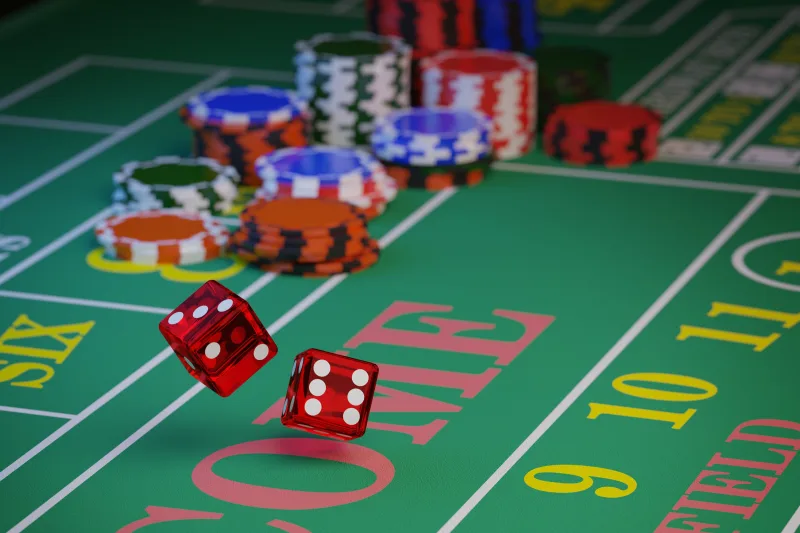
Craps looks noisy, but the low-edge part is narrow. The pass/come bet is 1.41% and don't pass/don't come is 1.36%. Odds bets on 4 or 10, 5 or 9, and 6 or 8 are listed at 0.00%, but they sit behind a line bet and do not create a profit engine.
Stick to line bets plus odds if edge is the priority. Avoid any seven at 16.67% and hop or hardway bets unless you accept the extra cost.
Baccarat
In baccarat, Banker carries 1.06% and Player 1.24%, making Banker the stronger of the two main bets on house edge. The Tie is the trap at 14.36%. Baccarat also needs little decision-making after the stake is placed, so it is often easier to play correctly than blackjack. Correctly does not mean profitably. For drawing rules, see baccarat rules, third-card rules and odds.
Roulette
Wheel choice matters: single-zero roulette is 2.70%, while double-zero roulette is 5.26%. French roulette with La Partage returns half the even-money bet when zero lands; using that rule gives a 1.35% house edge on even-money bets. The best roulette choice is therefore a La Partage even-money bet where offered, then single-zero. For every bet type, use the roulette odds and payouts table.
Slots
Slots are harder to rank because each game can have its own return setting. Each slot's house edge is 100% minus its published RTP, so a 96% game carries 4%. In practice: read the game information screen and favour the highest disclosed return, while accepting that volatility controls short-run results.
The largest advertised prize is not the same as the best odds. Online slots can be much faster than table games, so a modest edge can still become expensive. See online slots explained before comparing return figures.
The worst bets in the casino
Bad bets are often attached to familiar games, which makes them easy to underestimate. A baccarat table can contain a reasonable Banker bet and a costly Tie bet. A craps layout can contain low-edge line bets and expensive proposition bets within arm's reach. The American top line house edge is 7.89%. These bets also carry steep built-in costs.
- Baccarat Tie: 14.36%. The Tie may look attractive because it resolves in one hand and pays more than the main bets, but the edge is far above Banker at 1.06% and Player at 1.24%.
- Craps any seven: 16.67%. This is a high-cost proposition bet, not a substitute for the pass/come bet at 1.41% or don't pass/don't come at 1.36%.
- Craps hard ways and hops: hard 4 and hard 10 are 11.11%, hard 6 and hard 8 are 9.09%, and one-roll hops on 2 or 12 paying 30:1 are 13.89%. They can add excitement, but they also add a much higher expected cost than the line bets.
- Big Six: $1 is 11.11%, $2 is 16.67%, $5 is 22.22%, $10 is 18.52%, $20 is 22.22%, and Joker/Logo is 24.07%. The simple format does not make it cheap.
- Keno: the paytable sets the edge, so read the published return before playing. Slow pace can hide a large edge.
House edge vs hourly cost
Expected hourly loss equals stake multiplied by decisions per hour multiplied by the house edge. This is the practical reason a low stake on a fast game can cost more per hour than a larger stake on a slow game. The table shows worked examples in US dollars, not predictions for any session.
Game and bet | Stake | Assumed decisions per hour | Expected hourly cost |
|---|---|---|---|
Blackjack, basic strategy (0.48%) | $10 per decision | 70 | $3.36 |
Baccarat Banker (1.06%) | $10 per decision | 70 | $7.42 |
European roulette (2.70%) | $10 per spin | 40 | $10.80 |
Online slot at 96% RTP (4% house edge) | $1 per spin | 600 | $24.00 |
The decision rates are assumptions for these examples, and speed matters as much as edge.
The blackjack example also shows why poor play matters. The worked cost uses the 0.48% basic-strategy edge. If a player uses a much weaker approach, the house edge no longer matches the table.
The stake may look identical, but the mathematical cost has changed. That is why asking which game wins money is the wrong question. The realistic question is which game has the lowest cost under rules you understand and a pace you can control.
Slots show the opposite problem. A small stake can feel safer, but the number of spins can rise quickly. The online slot example uses a 96% RTP, equivalent to a 4% house edge, and still has the highest expected hourly cost in the table because of the assumed speed.
Any comparison should therefore include pace, not just return. Autoplay, quick spin controls and repeat-bet buttons can raise exposure even when the displayed stake is modest.
Online and land-based odds
Online and land-based comparisons usually mix two issues: the edge and the format. Online play does not automatically improve the maths. A blackjack table with more favourable rules is not the same product as a table with restrictive doubling or splitting.
A roulette game with a single-zero wheel is not the same as a double-zero wheel, and a slot with a published return is not comparable with one where you have not checked the help screen.
Land-based play has its own traps. Table minimums can push the stake higher than planned. Side bets are visible on the felt and can make a low-edge game expensive.
Slower dealing can reduce the number of decisions, but it does not improve a bad bet. If the game is Big Six, keno or a high-edge craps proposition, slower pace only reduces the speed of the expected loss.
Online play can feel cheaper because individual stakes may be small, but pace changes the cost. A fast slot session can contain far more decisions than a live table, even with a smaller stake.
Live dealer and land-based tables move at table speed, which can reduce exposure per hour but may carry higher minimum stakes. The best comparison is not online versus land-based. It is rule quality, stake size, decisions per hour and whether you can stop at the limit you set.
For table games, check the rule screen before playing. In roulette, the difference between single-zero at 2.70% and double-zero at 5.26% is enough to change the ranking.
In blackjack, the 0.48% figure belongs to the model rules with basic strategy, not every blackjack table. In baccarat, the simple ranking is clearer: Banker at 1.06% beats Player at 1.24%, while Tie at 14.36% should not be grouped with the main bets.
Why no game gives you a lasting edge
Card counting, bonus hunting and promotion play can create favourable spots in theory, but practical limits usually decide the outcome. Rule changes, bet limits, game exclusions, stake caps, identity checks and account restrictions can all remove the advantage. A favourable calculation also needs enough eligible play and low enough cost. Use expected value in gambling to separate a real positive calculation from a guess.
The ordinary version of each game is built around negative expected value for the player. Low-edge does not mean player edge. Break-even does not mean profit either. Craps odds bets carry no house edge, but they are linked to a line bet. They reduce the combined cost of the craps position, yet they do not turn the whole game into a lasting advantage by themselves.
Betting systems do not change the house edge. Raising stakes after losses changes bet size, not the underlying average return. A lasting edge would mean your whole allowed play has positive expected value after restrictions.
The games in this ranking do not give that by default. If you play, set boundaries before the session and use deposit limits, loss limits and reality checks rather than chasing a result.
The same applies to a game that simply feels fair. A fair random game can still be negative for the player if the payouts are set below the true odds. That is the normal casino model. Published rules, clear paytables and a known house edge help you price the entertainment. They do not remove the casino's long-run advantage.
What this means for your bankroll
Choose the lower-edge version only after you know the rules and can play the required strategy. If not, a simpler low-edge bet may cost less than a skill game played badly, though the house still has the long-run advantage. Do not choose by the biggest advertised prize. A top prize describes payout size, not the average cost of play.
A practical shortlist is narrow. Blackjack with correct basic strategy under favourable rules, craps line bets with odds, baccarat Banker and single-zero or La Partage roulette have the best odds in the figures above. The exact order depends on the rule set and bet type, not the game name alone.
Once the edge is acceptable, control the parts you can control. Set the stake before the session. Decide how many decisions or how much time you are willing to buy. Avoid adding side bets just because they are on the screen. If control is becoming difficult, stop play and use gambling helplines and support services by country.
Frequently asked questions
Which casino game is easiest to win?
If easiest means the simplest low-edge decision, Banker at 1.06% fits, and the player makes no drawing decisions after betting. If easiest means a guaranteed winning session, no casino game can provide that. Short-term luck can overpower the edge either way.
What has better odds, blackjack or roulette?
With basic strategy under our model rules, blackjack has a 0.48% edge. Single-zero roulette carries 2.70% and double-zero roulette 5.26%, so blackjack is better under those rules if you can play the strategy accurately.
Do slots have the worst odds?
Not always. A slot's edge is 100% minus its published RTP, so a 96% game carries 4%, while the Big Six joker carries 24.07%. A slot with a better disclosed return can beat many high-edge table side bets, but speed can still make it costly.
Is there any casino game where the player has an edge?
In this ranking, no standard game gives the player a lasting edge by default. Craps odds bets carry no house edge, but those bets are attached to a line bet and are break-even, not player-favourable. Promotions or advantage techniques need separate expected-value maths and practical limits.