Roulette odds and payouts (full table)
Every European roulette bet carries a 2.70% house edge and every American bet 5.26%, with the American top line worse still. The full table of payouts, true odds and win chances is below.
Roulette odds and payouts table
Use this reference with the main roulette guide when comparing standard wheel bets across European, American and French rules.
Bet | Numbers | Payout | True odds (European) | Win chance European | Win chance American | House edge European | House edge American |
|---|---|---|---|---|---|---|---|
Straight up | 1 | 35:1 | 36:1 | 2.70% | 2.63% | 2.70% | 5.26% |
Split | 2 | 17:1 | 35:2 | 5.41% | 5.26% | 2.70% | 5.26% |
Street | 3 | 11:1 | 34:3 | 8.11% | 7.89% | 2.70% | 5.26% |
Corner | 4 | 8:1 | 33:4 | 10.81% | 10.53% | 2.70% | 5.26% |
Six line | 6 | 5:1 | 31:6 | 16.22% | 15.79% | 2.70% | 5.26% |
Dozen or column | 12 | 2:1 | 25:12 | 32.43% | 31.58% | 2.70% | 5.26% |
Red or black, odd or even, high or low | 18 | 1:1 | 19:18 | 48.65% | 47.37% | 2.70% | 5.26% |
First four (0, 1, 2, 3), European only | 4 | 8:1 | 33:4 | 10.81% | – | 2.70% | – |
Top line (0, 00, 1, 2, 3), American only | 5 | 6:1 | – | – | 13.16% | – | 7.89% |
The payout column shows the casino payout on a winning bet, true odds show the mathematical odds against the hit, win chance is per spin, and house edge is the long-run expected loss per stake. Most American roulette bets carry the normal American edge, but the top line is the exception, with a 7.89% edge.
The table also separates probability from expected value. A bet that covers more numbers wins more often, but the payout is lower. A bet that covers fewer numbers wins less often, but the payout is higher. On a standard wheel, that trade-off keeps the house edge the same across ordinary bets within the same rule set.
This matters because players often use “best odds” to mean “highest chance of a hit”. That is not the same as lowest house edge. Red or black has a much higher hit rate than a straight-up number, but on the same standard wheel neither changes the mathematical cost of the wager.
Payout vs true odds: where the house edge comes from
Roulette payouts are shorter than the true odds. The standard straight-up payout is 35:1, but the true odds against that hit on a European wheel are 36:1. The gap between fair odds and the paid odds is the house edge, not a sign that the wheel remembers past results or favours particular outcomes.
The edge is 1 minus (payout plus returned stake) multiplied by numbers covered, divided by total pockets. For a European straight-up bet, the bet covers 1 number and the paid return falls short of the fair return for a single-zero wheel.
The calculation resolves to a 2.70% house edge. Put another way, $100 in total stakes on standard European roulette has an expected loss of $2.70.
The same calculation works for every line in the table. Larger coverage increases hit rate, but the listed payout falls in step. That is why a European split has a 5.41% win probability and a European even-money bet has a 48.65% win probability, yet both still carry a 2.70% house edge. For the probability background behind this formula, see the gambling maths guide.
Expected value is a long-run average, not a prediction for the next spin. A player can win a short session on a negative expectation game, and can lose quickly on a low-edge bet. The house edge only tells you the average cost per unit staked over repeated play.
The same idea explains the difference between European and American roulette. Standard European bets have a 2.70% edge, while standard American bets have a 5.26% edge. On equal staking, the American figure is 1.95 times the European figure. That is a rule difference, not a betting pattern difference.
European, American and French roulette
The wheel type and zero rule matter more than the position of the chip. The ordinary layout may look similar, but the number of zero outcomes and the treatment of zero change the long-run cost.
European roulette
European roulette is the single-zero format behind the European columns in the roulette odds table. All ordinary listed bets carry a 2.70% edge, whether the bet covers 1 number, a row, a dozen, a column or an even-money group. The first four bet is the special single-zero layout bet covering 0, 1, 2 and 3. It pays 8:1 and still carries the 2.70% edge.
The practical point is simple: on a European wheel, the inside or outside label does not decide the expected value. The wheel rule does. A straight-up bet has a 2.70% win probability, while red or black has a 48.65% win probability, but the edge is the same for standard bets.
American roulette
American roulette uses the extra 00 pocket, while the ordinary payouts stay in the same shape. Standard inside and outside bets have a 5.26% house edge, which is 1.95 times the European edge. The American top line covers 0, 00, 1, 2 and 3, pays 6:1 and has a 7.89% edge. That is why it stands out in any roulette odds chart.
The extra zero outcome reduces the win probability across ordinary bet types. A straight-up bet wins 2.63% of spins on an American wheel, and even-money bets win 47.37% of spins. The payout schedule does not compensate for that extra losing outcome, so the expected loss rises.
French roulette
French roulette uses one of two zero rules for even-money bets. La Partage returns half the stake when zero lands, reducing those bets to a 1.35% house edge.
Under En Prison, an even-money bet caught by zero is held for the next spin; if it wins then, the stake is returned without winnings. These rules apply to even-money bets, not to the ordinary inside bets in the table.
That makes French roulette different from simply using French bet names. A layout can show French call bets without applying La Partage or En Prison. The key check is the zero rule for even-money wagers. If that rule is absent, the ordinary single-zero edge applies.
Inside bets vs outside bets
Inside bets sit on specific numbers or small groups: straight-up, split, street, corner and six line. Outside bets cover larger labelled groups: dozens, columns, colours, odd or even, and high or low. On the same standard European wheel, both categories carry a 2.70% edge; on the standard American wheel, both carry a 5.26% edge, apart from the top line.
The difference is variance. Straight-up play produces long strings of losing spins more often, then relies on a larger hit to recover. Outside bets produce more frequent winning spins, but each win is smaller. Neither pattern makes the wheel more favourable. It only changes how results are distributed around the same expected loss.
After 20 European straight-up bets, at least one win leaves the set ahead; that chance is 42.19%. After 20 European even-money bets, being ahead requires 11 or more wins; that chance is 36.50%. The lower single-spin hit rate on straight-up is offset by the larger payout when it lands.
The average result is identical across standard bet types on a European wheel: 20 bets of $10 have an expected loss of -$5.41. The same principle scales with volume. On 100 spins of $10, the expected loss is $27.03 on European roulette and $52.63 on American roulette. On 1000 spins of $10, the expected loss is $270.27 on European roulette and $526.32 on American roulette.
This is why the riskiest-looking bet is not necessarily the most expensive in expected value. A straight-up bet is highly volatile, because it wins rarely. The American top line is more costly than ordinary American bets because its payout and coverage produce a 7.89% house edge.
Call bets and racetrack bets
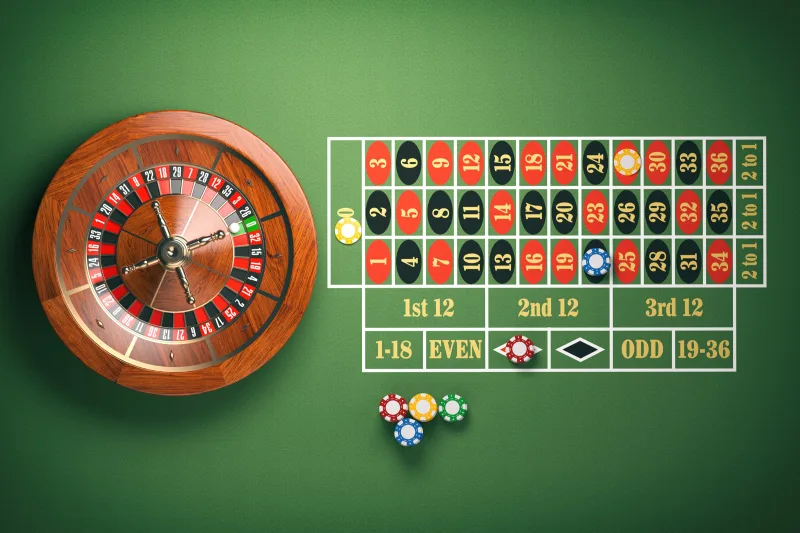
Call bets and racetrack bets are layout shortcuts, not separate odds. Voisins du Zéro, Tiers du Cylindre, Orphelins and neighbours are groups of ordinary inside bets placed together on wheel sections. The racetrack display makes those groups easier to select, especially on European-style layouts.
Because the total wager is split into ordinary inside bets, each piece keeps the wheel's usual house edge. A call bet can change coverage, stake distribution and volatility, but it does not create a new payout table. Treat it as a convenience feature, not a way to alter the underlying odds in roulette.
Neighbour bets work the same way. They select a chosen number and nearby wheel positions, then place ordinary inside bets according to the layout rules. The spin still resolves through the same wheel.
If the underlying table is single-zero, the ordinary European edge applies to the component bets. If the underlying table is American, the ordinary American edge applies unless a special bet has its own listed edge.
That distinction helps with online interfaces. A racetrack panel can make a bet look like a separate roulette product, but it usually sends several standard chips to the layout. The payout is still decided by the individual chip positions. If the interface offers a named special bet rather than standard chip placement, use the game paytable rather than assuming ordinary roulette odds.
Online and live roulette variants
Online and live variants can change the return through altered payouts, multipliers, wheel size or resolution rules. A published RTP or house edge is the safer comparison than the name of the bet, because a straight-up position in one variant may not pay like the same position on a standard wheel.
Variant | What changes | RTP or house edge |
|---|---|---|
Evolution Lightning Roulette | Evolution states that the game uses numbers 1–36 plus a single zero. Straight-up wins not selected for Lucky Payouts pay 29:1; one to five Lucky Numbers can receive 50x to 500x, and Lucky Payouts apply to Straight Up bets only. Other bet types use standard Roulette payouts. | Evolution's factsheet gives optimal RTP as 97.10% for Straight Up bets and 97.30% for all other bets. |
Double Ball Roulette | The game rules state that it uses a standard European single wheel and two balls to make two winning numbers. Inside bets win if either ball lands on a wagered number; outside bets require both balls to match the wager. Double Ball Jackpot pays 1,300:1. | RTP is 94.67%. |
Playtech Mini Roulette | Playtech Mini Roulette uses a 13-number wheel numbered 0 to 12. A single-number bet pays 11 to 1. A bet that does not cover zero loses only half if zero lands. | Bets that do not cover zero have a 3.85% house edge; bets that cover zero have a 7.69% house edge. |
Always check the game's own paytable before betting, because variant branding can hide a material change in payout or RTP.
Lightning-style games show why RTP matters. The headline feature is the multiplier range, but the non-multiplied straight-up payout is reduced. The return depends on the full mechanic, not only on the maximum multiplier shown on screen.
Double-ball rules also change the meaning of a win. Inside bets can be helped by either ball, while outside bets need both balls to fit the selected condition. That is not the same probability structure as a normal one-ball roulette spin, even though the wheel looks familiar.
Mini Roulette changes the wheel itself. The smaller set of outcomes comes with a different single-number payout and a zero rule for bets that do not cover zero. It should not be judged by standard European or American roulette payout instincts.
Can you improve your roulette odds?
You can improve the odds you accept only by choosing rules. On the figures above, European standard bets have lower expected loss than American standard bets, and French even-money bets with La Partage have the lowest listed edge. That is what people usually mean by the best odds at roulette: the rule set is better, not the prediction.
Betting patterns cannot change the wheel probabilities. Progressions, cancellation systems and hot-number play are covered in the betting systems guide and the gambler's fallacy guide; they may change bet size and volatility, not the edge. No number is luckier than another in a properly random game, and past reds, blacks or zeros do not make the next spin due.
Roulette is chance-based. Skill can help you avoid worse rules, unsuitable stakes and misunderstood bets, but it cannot turn a negative expectation wager into a positive one. The clearest improvement is to avoid higher-edge versions when lower-edge rules are available.
Before staking, set a loss limit or use tools explained in deposit and loss limits. A limit does not change the house edge, but it can stop a short session from becoming an unaffordable one. If gambling is causing harm, support options are listed in the gambling helplines guide.
What this means before you bet
Pick the rule set before you pick the number. Lower house edge is useful, but it only reduces the expected cost of play. For safer play basics, use the responsible gambling guide, and treat every spin as a paid chance event rather than a problem to solve.
If you want the lowest listed roulette edge in this reference, look for the French even-money zero rule rather than a staking system. If you want lower variance, outside bets give more frequent hits, but they do not improve expected value on their own. If you want the clearest comparison across unusual games, read the RTP and paytable first.
Frequently asked questions
What is the best bet in roulette?
On standard European and American tables, bet choice mainly changes volatility, because ordinary bets share the same house edge within each wheel type. The lowest listed edge here is on French even-money bets with La Partage at 1.35%, but that still leaves the house with an advantage.
What are the odds of hitting a single number?
A straight-up bet covers 1 number. The win chance is 2.70% on a European wheel and 2.63% on an American wheel. The standard payout is 35:1, while the true odds against are 36:1 on European roulette and 37:1 on American roulette.
Why does American roulette have worse odds?
American roulette has 38 outcomes because of the 00 pocket, but standard payouts do not rise to compensate. That makes the usual American house edge 5.26%, compared with 2.70% on European roulette. The American top line is worse again at 7.89%.
What is La Partage in roulette?
La Partage is a French roulette rule that returns half an even-money stake when zero lands. With that rule, even-money bets have a 1.35% house edge. It does not change the payouts on ordinary inside bets.